

In commercial cannabis cultivation, deciding to enrich with CO₂ is often straightforward. The key challenge is maintaining the intended concentration consistently without wasting gas, disrupting humidity control, or creating worker-safety risks.

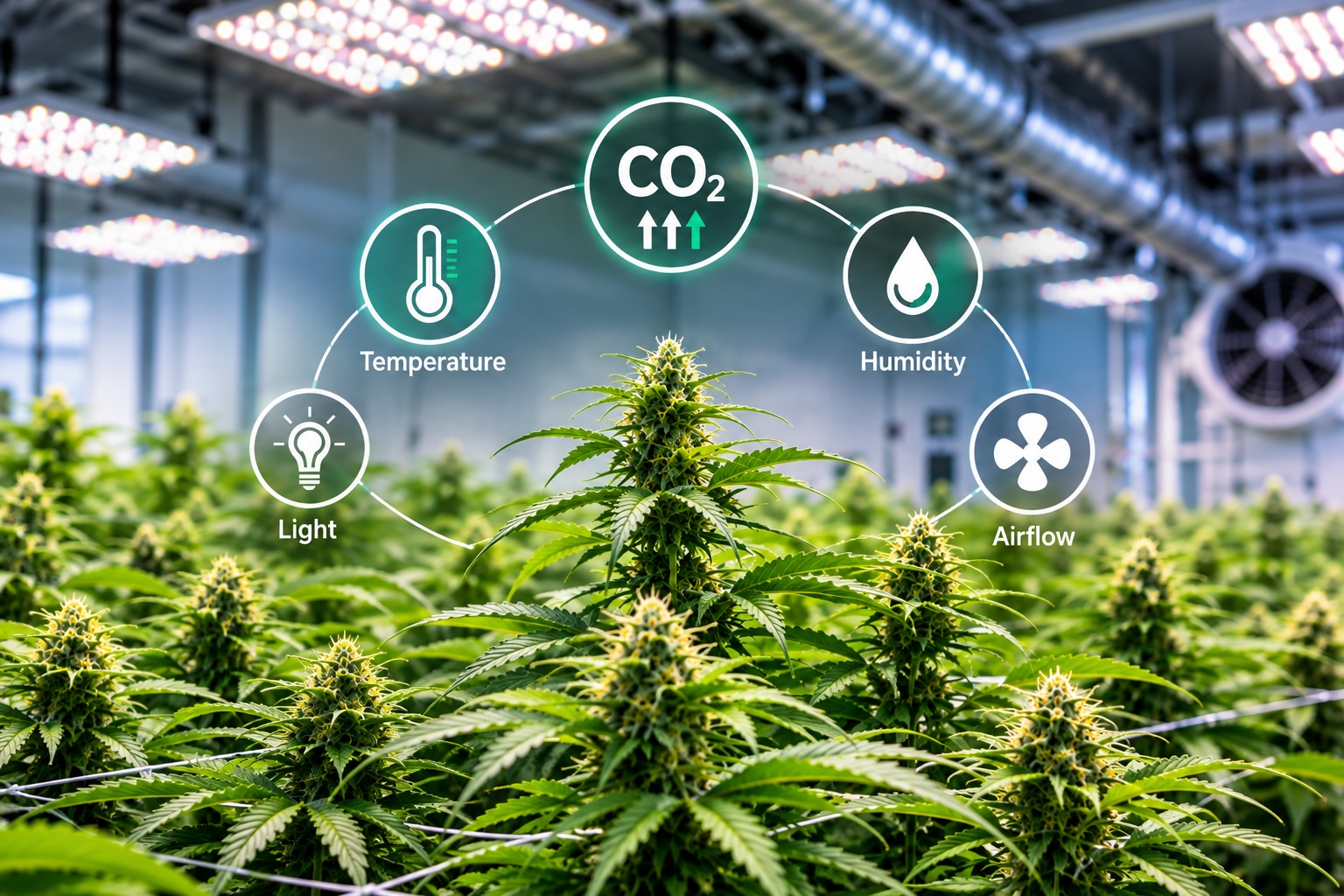
CO₂ enrichment works as part of an environmental system. Light intensity, leaf temperature, irrigation, air movement, dehumidification, HVAC operation, canopy density, and CO₂ concentration all affect one another. A controller that holds a nominal CO₂ setpoint is just one factor to consider.
For experienced cultivators, effective CO₂ management comes down to three priorities: maintaining the desired concentration at canopy level, coordinating enrichment with the rest of the mechanical system, and collecting enough data to recognize when the room is drifting away from its intended operating conditions.
CO₂ Enrichment Has to Match Canopy Demand
Adding more CO₂ does not automatically increase production.
Cannabis research has demonstrated that photosynthesis responds to CO₂ in combination with light and temperature. Earlier controlled-environment research found that photosynthetic response changed as CO₂ concentration, photosynthetic photon flux density, and temperature were varied. Other cannabis studies have also shown that crop-level yield response does not necessarily mirror leaf-level photosynthetic response.
A facility running high-intensity lighting may be able to use elevated CO₂ productively, whereas a lower-light strategy would provide little benefit. If temperature, irrigation, or other environmental conditions are not well controlled, those factors can limit plant performance before CO₂ becomes the primary constraint.
Instead of treating one concentration as universally optimal, cultivation teams should determine CO₂ targets in the context of a room’s:
- Light intensity and photoperiod
- Cultivar and crop stage
- Canopy density
- Temperature strategy
- Irrigation and substrate management
- HVAC and dehumidification capacity
- Air-exchange rate
This approach also makes cost analysis more useful by focusing on production gains relative to the cost of supplying and retaining CO₂.
A Room Setpoint Does Not Guarantee Uniform Canopy Exposure
One common weakness in CO₂ management is assuming a single sensor reading represents the entire room. That is not always the case.
CO₂ distribution depends on injection location, circulation fans, supply and return air patterns, canopy structure, room geometry, equipment placement, and leakage. Dense plant canopies can make spatial differences more pronounced.
That creates two problems at once. Some parts of the crop may receive less CO₂ than intended, while operators keep adding gas because a controller responds to a sensor elsewhere.
Commercial operations can reduce that uncertainty through well-designed CO₂ services that incorporate appropriate sensing, distribution, and control rather than relying on enrichment alone.
Sensor placement should reflect the conditions operators are trying to control. Monitoring at or near the active canopy can provide more useful cultivation data than a reading from a convenient wall location. Larger rooms may also warrant multiple measurement points to identify gradients.
Calibration matters as well. A drifting sensor can make an otherwise well-designed control strategy inefficient because the automation system is responding precisely to inaccurate information.
CO₂ Retention and Humidity Control Have to Be Engineered Together
This is especially important in humid climates.
Indoor cultivators often operate sealed or semi-sealed rooms partly because exhausting conditioned air also exhausts enriched CO₂. Retaining that air can improve CO₂-use efficiency, but it also means the facility must mechanically manage the moisture released through plant transpiration.
That moisture load can become substantial as canopy biomass increases.
The result is an important operational tradeoff: a room designed to retain CO₂ may also retain water vapor. If dehumidification and cooling systems cannot keep pace with the crop’s latent load, relative humidity can rise even while the CO₂ controller performs exactly as intended.
High-moisture conditions are particularly concerning because Florida cannabis regulations include microbial and other contaminants among substances that can make products unacceptable, and current testing rules include microbial testing requirements for finished products.
CO₂ automation should therefore communicate with, or at least be designed around, the room’s environmental-control strategy. Operators need visibility into CO₂, temperature, and humidity trends together.
A CO₂ system does not prevent mold. Precise environmental management helps prevent conditions that make contamination risk harder to control.
Trend Data Can Reveal CO₂ Waste Before It Becomes Expensive
One of the biggest advantages of automated monitoring is tracking historical trends over time.
A room that repeatedly drops below its setpoint can tell operators something about the facility itself.
For example, unusually high CO₂ consumption may indicate:
- Excessive exhaust or unintended air exchange
- Leaking doors or penetrations
- Poorly timed injection cycles
- Inadequate gas distribution
- Sensor drift
- HVAC sequences that remove enriched air unnecessarily
- Frequent personnel access during enrichment periods
The rate at which a room recovers after doors open or equipment cycles can also provide useful operational information.
This is where environmental controls become a cost-management tool rather than simply a cultivation tool. Instead of compensating for an unknown problem by supplying more gas, operators can identify why the room cannot maintain its intended concentration.
That can lower gas consumption without lowering the cultivation target.
CO₂ Should Be Scheduled Around Plant Demand
Commercial systems should also avoid treating CO₂ enrichment as a constant requirement.
Photosynthetic demand is primarily associated with the light period. Continuing to enrich when the crop cannot productively use the additional CO₂ wastes material and can unnecessarily increase room concentrations.
More advanced strategies can coordinate enrichment with lighting schedules and other environmental sequences rather than operating CO₂ as an independent system.
The same principle applies when rooms are accessed by employees. Control sequences can suspend injection during certain operating conditions, respond to alarms, or shut down gas flow when the room moves outside predetermined safety parameters.
The goal is controlled CO₂ delivery that maintains the desired concentration when enrichment provides the greatest value.
Crop Monitoring and Life-Safety Monitoring Serve Different Purposes
CO₂ is also an occupational safety issue.
OSHA’s permissible exposure limit for carbon dioxide is 5,000 ppm as an 8-hour time-weighted average. NIOSH also lists a 5,000 ppm recommended exposure limit, a 30,000 ppm short-term exposure limit, and 40,000 ppm as immediately dangerous to life or health.
Those concentrations are well above typical cultivation targets, but equipment failures, leaks, or uncontrolled releases can produce conditions very different from normal operation.
That is why crop-control sensing should not automatically be treated as a substitute for life-safety detection.
The 2024 International Fire Code also includes safety requirements for certain CO₂ enrichment systems. Section 5307.4 establishes requirements for systems containing more than 100 pounds of CO₂ and systems of any quantity with a remote fill connection. For these systems, the code specifies a low-level gas detection alarm at 5,000 ppm and a high-level alarm at 30,000 ppm. Alarm activation triggers safety measures, including stopping CO₂ flow and activating mechanical exhaust ventilation. Applicable requirements depend on the fire-code edition adopted by the jurisdiction and any local amendments.
For operators, the practical takeaway is simple: production controls optimize the crop. Safety controls protect people. Both require appropriate sensors, alarm logic, maintenance, and testing.
Better CO₂ Control Means Better Environmental Repeatability
At commercial scale, CO₂ control shapes far more than photosynthetic performance. It also affects how consistently a cultivation facility can maintain the environmental conditions the crop depends on.
A well-designed system gives cultivation teams visibility into where CO₂ goes, whether the canopy receives it consistently, how enrichment interacts with HVAC and humidity control, and whether gas consumption aligns with production demands.
That becomes particularly important in humid climates, where retaining enriched air without adequate moisture removal can undermine product-quality goals elsewhere in the room.
For commercial cultivators, CO₂ control adds value through the data and coordination it brings to the growing environment. When operators can track concentrations, identify inefficiencies, and respond to changing room conditions, CO₂ becomes a more precise production tool rather than another variable to manage manually.